


What is the Level(s) framework?
Level(s) is the EU initiative that joins up sustainable building thinking across the EU by offering guidance on the key areas of sustainability in the built environment and how to measure them during design and after completion.
Level(s) is not a certification system. It is the EU’s framework for defining what the EU consider to be the key objectives of sustainability in buildings, and how to measure them using indicators. It underpins EU decisions and directives – for example, the LifecycleGWP measurement requirement of the updated Energy Performance of Buildings Directive (EPBD) is based on indicator 1.2 of Level(s).
What do the Level(s) indicators cover?
At first glance Level(s) could be mistaken for another building certification scheme, but unlike such schemes, it doesn’t set benchmarks and is actually more of a set of tools to help with the many aspects of what sustainability means today. It is based on six overarching macro-objectives;
- Greenhouse gas emissions along a building’s life cycle
- Resource-efficient and circular material lifecycles
- Efficient use of water resources
- Healthy and comfortable spaces
- Adaptation and resilience
- Optimised life cycle cost and value
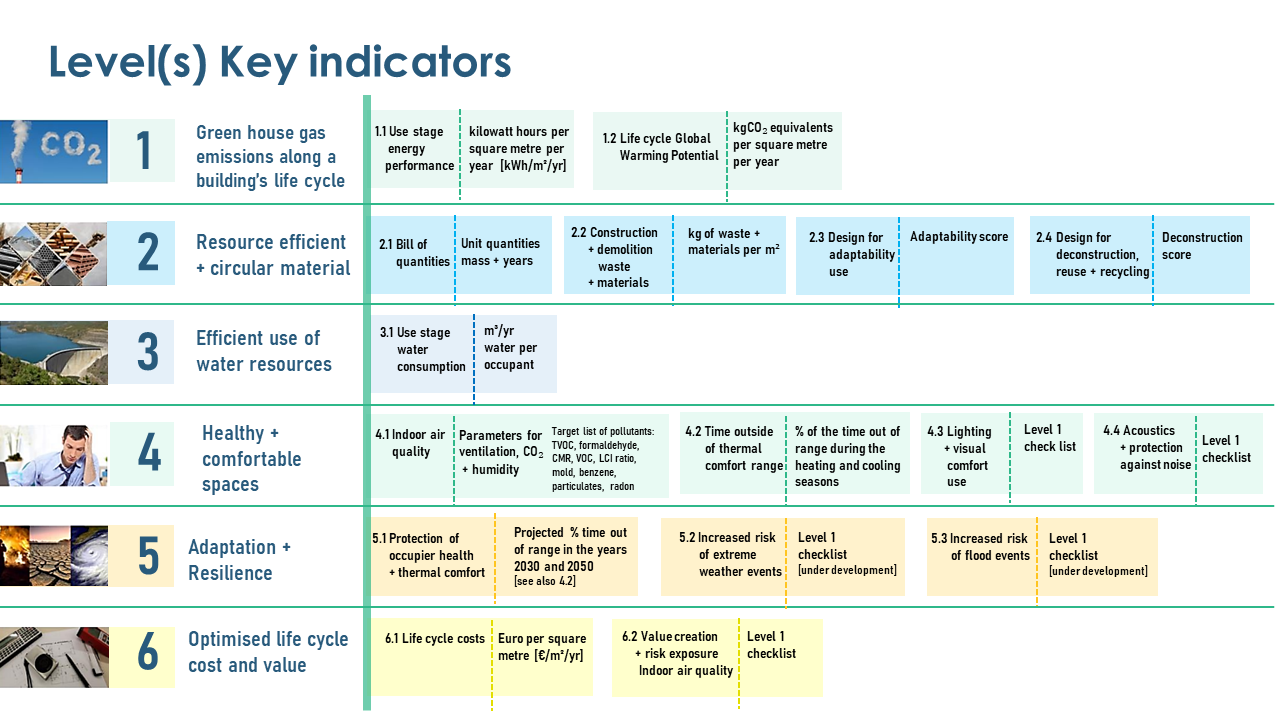
In turn, these are each supported by between two and four measurable indicators. As well as carbon emissions and costs, there are tools for measuring other aspects, such as the likely waste streams from the site, how adaptable a design may be in the future, and just how recyclable it is.
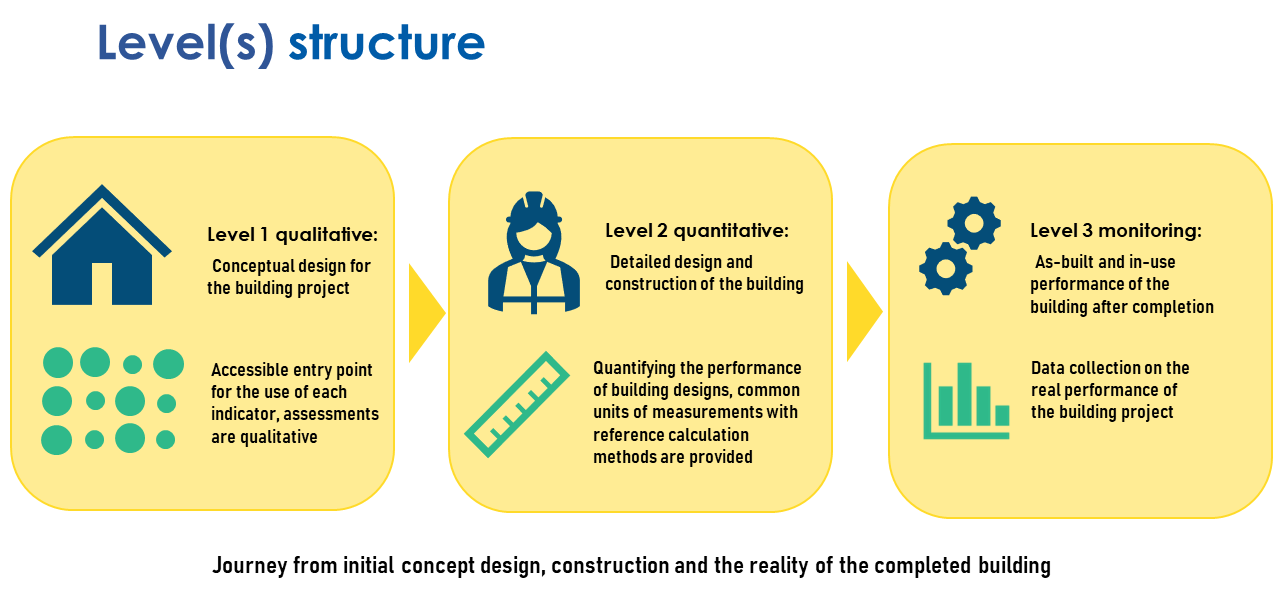
The three ‘levels’ involved synchronising with the workflow of a design and build project.
Level one guidance is all about informing yourself at the early stages of design. There are no metrics here; it is background reading on the subject to bring you up to speed quickly and guide your thinking on what is relevant and important to you and your client.
Level two is about taking a deeper dive into the areas you have identified as your main priorities and quantifying actuals in your technical designs to help make decisions based on data. There are recommendations on the international standards to use and the methodology that may be applied.
Finally, level three looks at actual monitoring and feedback, whether this be comparing actual on-site waste recycling to your level two estimates or ongoing post-occupancy monitoring of comfort, energy, water or other building performance. It’s there to establish what works in practice compared to the models.
Because all the indicators relate to the same building description template you complete at the start, they make buildings more easily comparable, which should contribute to the development of national metrics for each member state. As Europe’s climate and building stock requirements are not homogeneous, benchmarks will not be set at the EU level, and instead, EU member states are encouraged to develop their own.
The Irish Green Building Council is currently working towards aligning its own building certification scheme, the Home Performance Index, with Level(s). The aim is to create guidance that allows housebuilders to be sure they are focusing on the right metrics for both sustainability and long-term value.
What does the Level(s) involve?
Level(s) is delivered in the form of User Manuals and reporting templates. Each manual explains a sustainability concept, how to implement it and how to record and measure the results (using the templates). They can be used individually as standalone concepts, but work better when approached as a suite (as there is some overlap).
They are available for free download here.
These documents help project design teams focus on sustainability aspects and provide guidance on how to make accurate performance assessments. They also address the needs of clients and investors by offering advice on how cost and risk can be future-proofed by extending flexibility and lifespans and enhancing the long-term value of assets.
For policy Level(s) offers a clear set of prioritised performance indicators to focus on, together with a standardised basis for setting requirements. It provides a foundation that can contribute to carbon reduction target setting and broader sustainability objectives.
What are Level(s) Objectives?
The primary objective of the Level(s) framework is to create a common language for sustainability in the built environment across the EU.
Before Level(s), “sustainability” was a vague term. By providing a set of core indicators (like GWP, LCC, etc.), the EU has created a standardised vocabulary. This allows for clear communication and, crucially, benchmarking of building performance across Ireland and the rest of Europe. Level(s) is the rulebook that bridges the gap between high-level EU climate policy (like the Green Deal and EPBD) and the practical, on-the-ground reporting of a construction project (using tools like BoQs and standard reporting templates). For Ireland, its first impact is providing the framework and knowledge for mandatory LifecycleGWP reporting under the EPBD.
 Level(s) and Life Cycle Assessment Training
The IGBC is currently offering an introductory course to help practitioners understand the methodology and mechanics of Indicator 1.2: life cycle global warming potential (GWP) called Embodied Carbon 101.
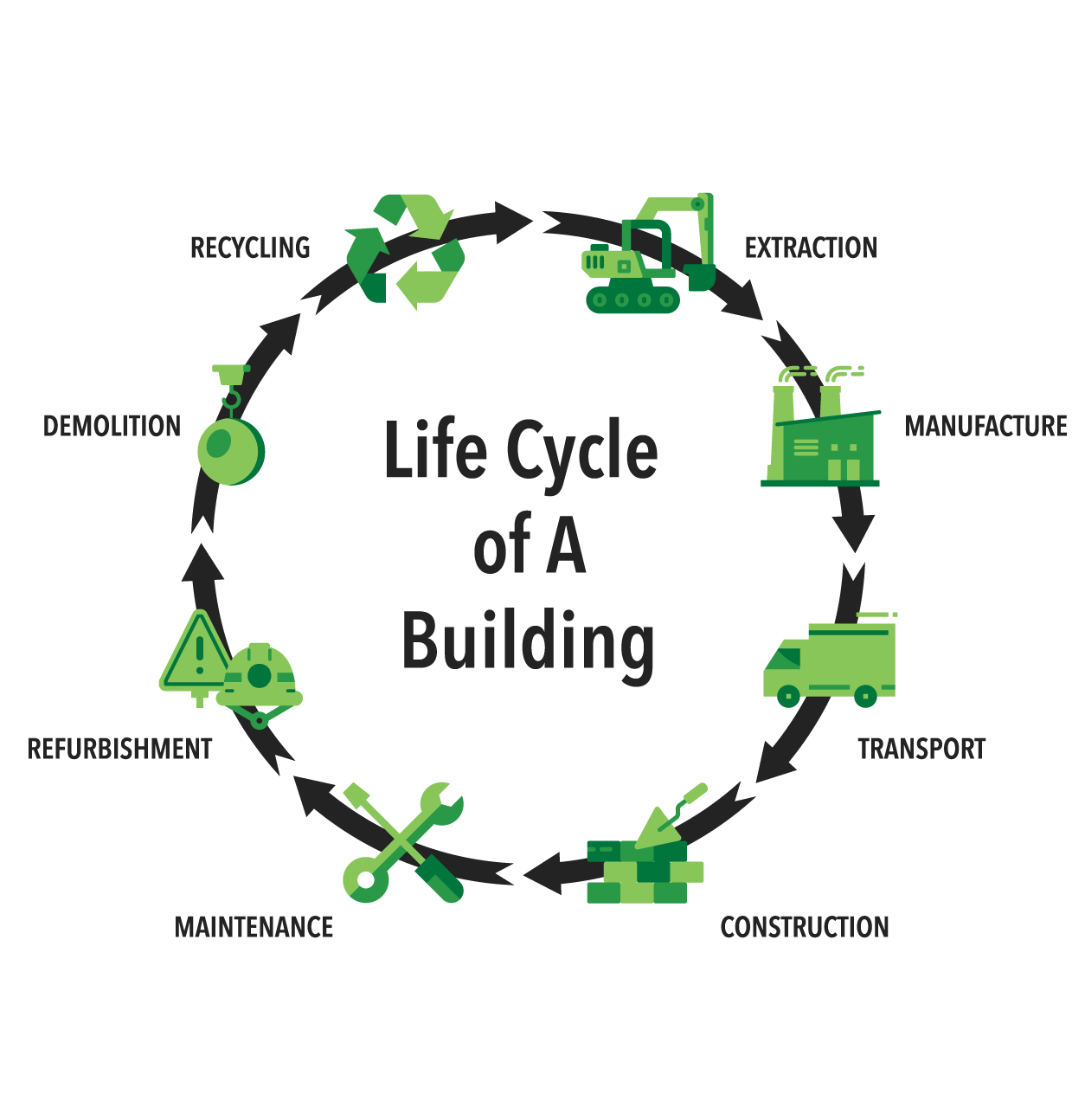
Indicator 1.2 takes a whole life carbon approach – incorporating design decisions that are also addressed in some of the other indicators, such as indicator 1.1 (use stage energy consumption), indicator 2.1 (bill of quantities, materials and lifespans), indicator 2.2 (construction and demolition waste and materials), indicator 2.3 (design for adaptability and renovation) and indicator 2.4 (design for deconstruction and recycling). This gives the design team a useful overarching view when considering the future of any building project.
Life Level(s) Project
The Irish Green Building Council partnered with 8 European Green Building Council to mainstream sustainable buildings in Europe through greater awareness and use of the specified indicators within the framework of Level(s). The key indicators are Life cycle assessment (LCA), Life cycle costing (LCC) and Indoor air quality (IAQ).
The project is now completed and partners developed a Best Practice Guide to Support Incorporating Level(s) Indicators into Public Procurement Processes.
 Life for LCA LCC Level(s) project (short: LIFE Level(s) and has received funding from the LIFE Programme of the European Union. The project will last for three years, from 2019 until 2022.
Certification
Related content
-
Water Label
The Unified Water Label is a European-wide initiative by companies involved in the bathroom industry. It’s a smart tool that provides a means to identify water-using products with a common label that offers clear, concise and easy-to-understand messaging about water energy usage. -
Level(s) – EU Sustainable Buildings Framework
Level(s) is the EU initiative that joins up sustainable building thinking across the EU by offering guidance on the key areas of sustainability in the built environment and how to measure them during design and after completion. -

Green Building Accredited Certifiers
Access a full list of IGBC Members who are LEED, BREEAM, HPI and WELL accredited professionals -
BREEAM
Information on the BREEAM multi criteria environmental assessment system and its application in Ireland -
LEED
Learn more about LEED, a widely used rating system for green buildings developed by the U.S. Green Building Council.