


Wrapping Up Ireland’s CO2 Performance Ladder Pilot Project – A Major Milestone in Green Public Procurement
Ireland’s two-year pilot of the CO2 Performance Ladder (2023-2025), led by the Irish Green Building Council (IGBC) in...

About the author

Ireland’s two-year pilot of the CO2 Performance Ladder (2023-2025), led by the Irish Green Building Council (IGBC) in partnership with the Foundation for Climate Friendly Procurement and Business (SKAO), has officially concluded, marking a significant milestone as the country moves into a full implementation phase. The pilot’s completion signals a growing national commitment to embedding structured carbon reduction practices within public procurement and across the wider construction and infrastructure sectors. The pilot has demonstrated not only that the CO₂ Performance Ladder is feasible and effective within the Irish context, but also that it has the potential to drive meaningful carbon reduction and cultural transformation across the built environment.
How the Pilot Worked
Transport Infrastructure Ireland (TII) played a central role in the pilot as the first procuring authority to test the CO₂ Performance Ladder implementation. As part of the trial, TII integrated the Ladder as an award criterion into its tendering process of the M7 Kildare Bypass High Speed Pavement Scheme. All five tenderers opted to pursue certification under the Ladder, demonstrating strong industry engagement from the outset. Jons Civil Engineering was selected as the main contractor, committing to reach Level 4 on the Ladder. Kilsaran contributed significantly as a project subcontractor, while AtkinsRéalis supported the project in its role as designer and employer representative. Together, these organisations helped demonstrate how the Ladder can be effectively embedded across a full project supply chain. The integration of the CO₂ Performance Ladder delivered striking results. Jons Civil Engineering reported an 84.5% reduction in Scope 1 and 2 emissions, alongside a 20.3% reduction in Scope 3 emissions, amounting to a total saving of 311 tonnes of CO₂e (source).
From Ambition to Delivery: TII’s Reflections on the CO₂ Performance Ladder Trial
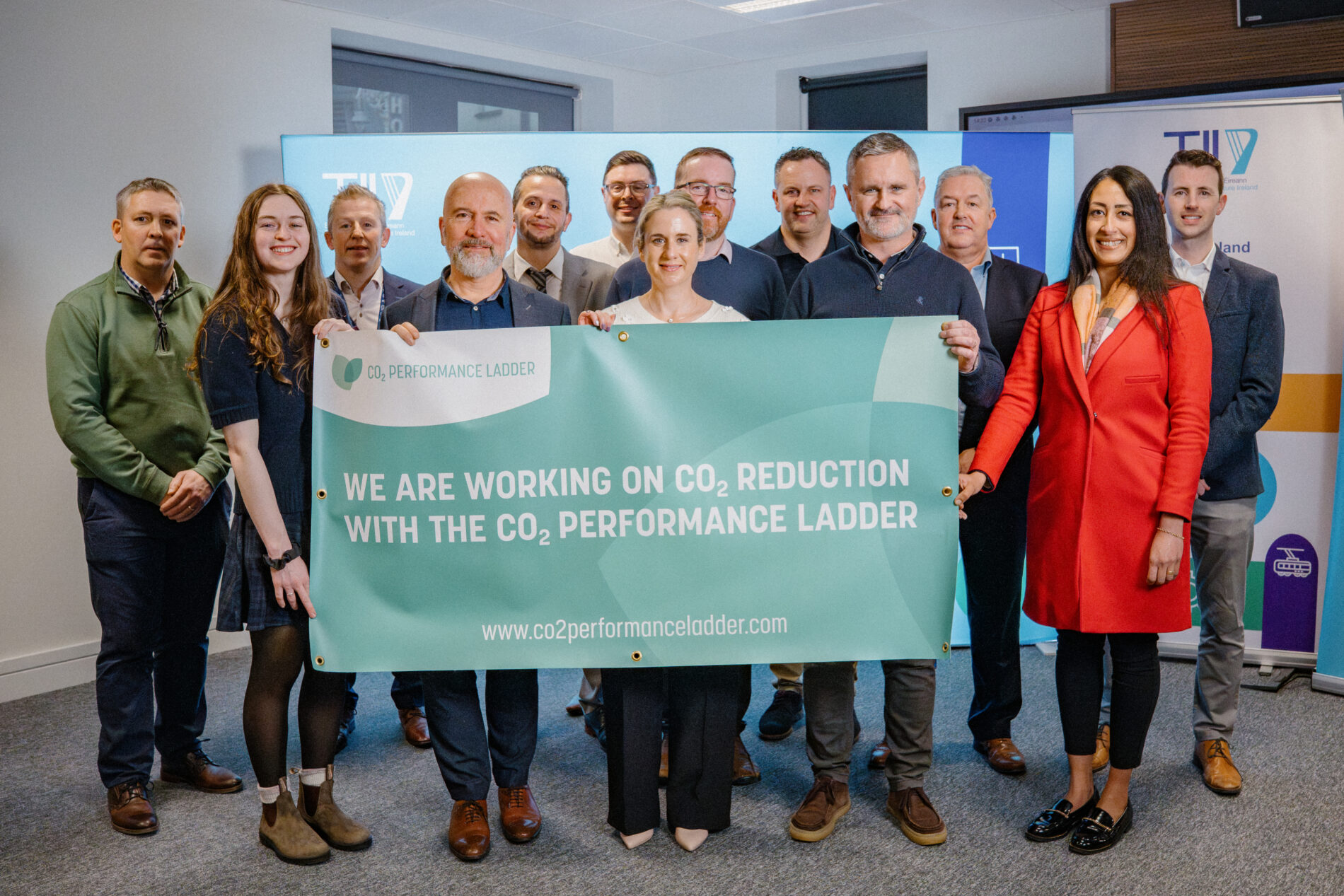
Speaking at the pilot wrap‑up event held at TII’s offices, Paul Farrelly, Head of Procurement at TII, highlighted that the Ladder helped the organisation translate its strategic climate ambitions into practical on‑site delivery. He also emphasised that the early market engagement and supplier preparation were essential to ensuring the smooth and effective rollout of the Ladder across tenders and projects.
Stephen Smyth, Senior Manager – Pavement Asset Management Programme & Winter Services and PJ Hourigan, Asset Management Engineer, noted that the most beneficial aspect of the Ladder is its “focused and tangible” approach to delivering on objectives. Unlike high-level climate strategies, the Ladder embeds carbon reduction activities directly into the subject matter of the contract. Smyth also discussed how the Ladder strengthened relationships with suppliers and designers by demonstrating TII’s genuine commitment to decarbonisation. Once contractors saw that TII was actively delivering results on site, it encouraged more proactive carbon-reduction behaviours throughout the supply chain.
Industry Feedback from Across the Supply Chain
Carmel McHugh, Contracts Manager and Dimitris Michailidis, Technical Manager – Road Surfacing & Operational Improvement, from Kilsaran, also reflected on the significant impact of the initiative. Michailidis noted that participating in a project using the CO₂ Performance Ladder fundamentally changed how they approach sustainability in procurement across the construction sector. One of the clearest successes was the large‑scale use of Reclaimed Asphalt Pavement (RAP) on the M7 Kildare Bypass. This marked the first time RAP was permitted on an Irish motorway, a milestone made possible by the structure and guidance of the CO₂ Performance Ladder, which supported the application of innovative solutions to achieve carbon reductions. According to McHugh, industry interest in RAP has grown substantially since the pilot, with many companies now recognising both its feasibility and its strong environmental benefits.
AtkinsRéalis, played a key role in integrating the Ladder into the tender documentation. This included embedding carbon‑reduction commitments directly into the pricing model, making them binding once the contract was signed. Dara Crosbie, Associate Director and Andrew Butterly, Project Engineer at AtkinsRéalis highlighted that the Ladder introduced a meaningful new dimension to the tendering process, by incentivising contractors to pursue ambitious carbon reductions.
Beyond the M7 scheme, AtkinsRéalis confirmed that the Ladder has now been integrated into all the upcoming tenders across TII’s high‑speed pavement renewal framework, demonstrating TII’s commitment to scaling the Ladder beyond the initial pilot and embedding it more widely across its procurement activities.

Achievements and TII’s Next Steps
TII’s work with the CO2 Performance Ladder has earned national recognition, with the M7 project receiving multiple honours, including the Engineering Excellence Award, Environmental Project of the Year 2025, and the Best Green Public Procurement Project of the Year 2025. These achievements are driving growing momentum towards wider adoption of the Ladder across the country. The Irish pilot has demonstrated the tool’s strong compatibility with national procurement structures, diverse project types, and existing supply chain capabilities. Building on this success, TII has now embedded the Ladder into three new four‑year frameworks: the Signs Maintenance Framework, the Delineation Programmes Framework, and the Vehicle Restraint System Framework. As of late 2025, three organisations, Roadstone, Jons Civil Engineering, and Colas JV, have achieved Ladder Company-wide certification. These early adopters report significant benefits, including improved data quality, stronger internal decision‑making, and greater collaboration throughout their supply chains, underscoring the Ladder’s potential as a transformative tool for decarbonisation in Ireland’s built environment.
Conclusion: Towards National Implementation
The wrap‑up of the Irish pilot project of the CO₂ Performance Ladder marks a decisive step forward in the built environment’s commitment to measurable carbon reduction and the structured implementation of GPP. With the pilot now complete, the Irish Green Building Council is preparing for a broader national rollout, supported by funding from Construct Innovate, Ireland’s national research centre for construction technology and innovation, to upscale the Ladder’s implementation throughout 2026-2027. This next phase will focus on building more capacity of public procurers and their contractors, enabling more consistent adoption of the system. Several public bodies have already expressed strong interest in joining the initiative, and TII has pledged to support organisations ready to advance their carbon management practices. With proven success and increasing uptake across sectors, the CO₂ Performance Ladder is set to become a cornerstone of Green Public Procurement and a key driver of carbon reduction nationwide.

Want to know more about the CO2 Performance Ladder? Get in touch with Programme Manager, Marianne.
News
More news from IGBC
-

Faster decarbonisation of buildings will increase resilience to energy price shocks
Progress has been made on policies to decarbonise our built environment in recent years but the government must... -

Roadstone – Becoming the First Company in Ireland to Achieve Level 5 on the CO2 Performance Ladder
Introduction Roadstone Ltd, one of Ireland’s leading supplier of construction materials, has become the first company in Ireland... -

New research points way toward vibrant, nature-rich neighbourhoods
New research points way toward vibrant, nature-rich neighbourhoods Dublin, 11 May 2026: Better alignment between government policies and... -

Building for Biodiversity: IGBC and Local Authorities Join Forces
Local authorities, environmental experts, and construction professionals convened on the 14th April in Portlaoise for a landmark workshop... -

Wrapping Up Ireland’s CO2 Performance Ladder Pilot Project – A Major Milestone in Green Public Procurement
Ireland’s two-year pilot of the CO2 Performance Ladder (2023-2025), led by the Irish Green Building Council (IGBC) in... -

South East Energy Agency is Hiring
At South East Energy Agency, we’re expanding, and we’re looking for talented people to join us. Current opportunities:...