



Overcoming Barriers to Nature-Led Residential Developments at Scale
Ireland is at a crucial moment in shaping the future of its built environment. As the country faces...
 Eco Park in Clay Farm, a development by Park Developments
About the author

Ireland is at a crucial moment in shaping the future of its built environment. As the country faces rising housing demand, with a target of 50,000 new homes per year by 2040, the decisions made today will have long-term consequences for people, places, and the planet.
A Turning Point for Ireland’s Built Environment
Construction is one of the key contributors to biodiversity loss through habitat destruction, pollution, resource use, and emissions, both on-site and across supply chains. However, our sector holds the potential to reverse some of that damage by embedding Nature directly into the way we plan, design, and build our communities.
The BIO-NEIGHBOUR project, led by the Irish Green Building Council in partnership with Trinity College Dublin and funded by the Housing Agency, is investigating how nature-led residential development can become the norm rather than the exception in Ireland. This blog post – by Irene Rondini, project partner with IGBC – presents the project’s initial findings, identifying key barriers that hinder large-scale implementation, while also offering early insights into potential solutions.
Defining Nature-Led Residential Development
As part of the BIO-NEIGHBOUR, a working definition of “nature-led residential development” has been developed to guide analysis and engagement:
“Nature-led residential developments mean the overall ecological impact of a project, including land use, construction, supply chains, and occupation, results in a demonstrable enhancement of biodiversity and supports long-term ecological resilience, accounting for both direct site-level impacts and indirect embodied ecological impacts.
This should be achieved by recognising existing site conditions, implementing the mitigation hierarchy (avoid, minimise, restore, compensate), prioritising like-for-like nature restoration where possible, enhancing ecological connectivity, and securing long-term management and monitoring”.
This definition is still evolving and will be refined as the project progresses, reflecting lessons learned from research, stakeholder engagement, and practical testing.
Limited Progress, Growing Awareness
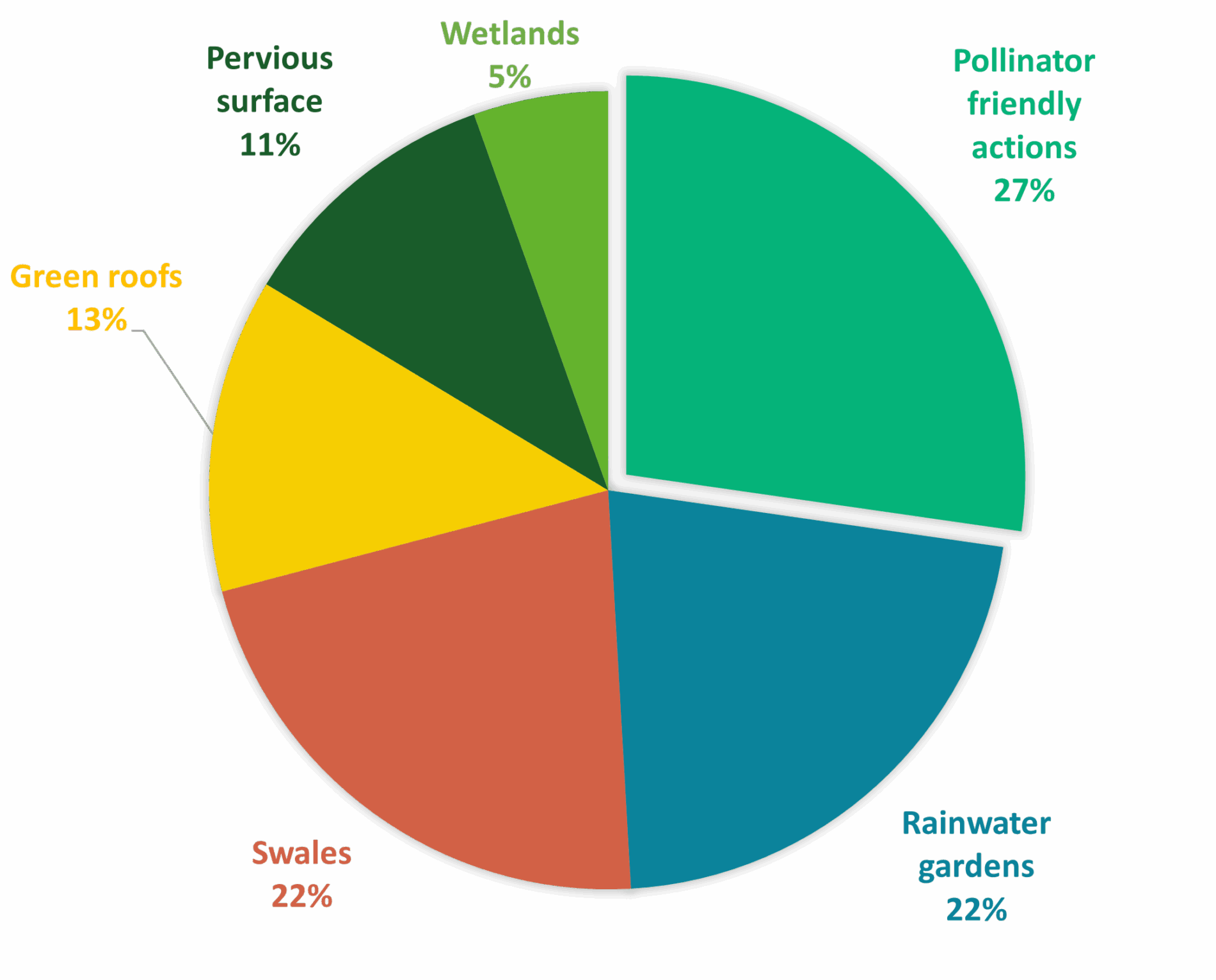
Due to limited data on nature-led residential development in Ireland, the research uses green infrastructure (GI) and nature-based solutions (NbS) as proxies.
The findings indicate that the integration of these solutions in residential developments is limited but growing, as awareness and interest are increasing. Commonly used NbS include pollinator-friendly actions, rainwater gardens, and swales, but often as an isolated or one-off solution.
Drivers of implementation vary. Public sector projects tend to be influenced by climate adaptation policies, while private developments are often shaped by consumer preferences. Encouragingly, general awareness of biodiversity and NbS within the construction sector has improved over the last decade.
However, the gap between awareness and action remains significant. Without a clear framework to support the design and delivery of nature-led developments at scale, opportunities are being missed.
Unpacking the Barriers
The research highlights several barriers that must be addressed if nature-led development is to become the new norm:
- Policy and Regulation: Ireland currently lacks binding national policies or a consistent framework for integrating biodiversity into residential development. This leads to fragmented practices across local authorities, inefficiencies, and missed opportunities.
- Knowledge and Skills: Many developers, planners, and construction professionals lack the tools, training, and understanding needed to design with nature in mind. There’s also limited awareness of the embodied ecological impacts of materials and supply chains, an area that requires further attention.
- Access to Expertise: Ecological expertise is not always available during the early stages of project planning. When ecologists are brought in too late, their ability to shape design decisions is limited, reducing the overall impact of nature-based interventions.
- Long-Term Maintenance: Once developments are completed, there is often no clear responsibility or funding model for maintaining green infrastructure. This raises concerns about the long-term survival and effectiveness of nature-based features, especially in public or shared spaces.
- Financial Barriers: Nature-led features often lack dedicated funding or incentives, particularly when it comes to public realm improvements or ongoing maintenance. Developers may be reluctant to invest without clear returns or support from public funds.
Early Recommendations and Opportunities for Action
The BIO-NEIGHBOUR offers several early recommendations to help overcome these challenges and move Ireland closer to embedding biodiversity at scale in residential development:

- National Regulation: Introduce binding requirements, such as a national Biodiversity Net Gain (BNG) policy, to create a consistent standard and signal to the market that nature-led development is a priority. Simplicity and clarity will be key to ensuring adoption by industry stakeholders.
- Integrated Planning: Update planning and building regulations to include biodiversity requirements and ensure that ecologists are involved from the earliest stages of project design.
- Training and Resources: Develop a national biodiversity knowledge hub to support upskilling across the sector. This would provide practical tools, case studies, and guidance to help planners, designers, and developers embed nature in their work.
- Financial Innovation: Explore new funding mechanisms, such as ecological bonds, green infrastructure grants, or targeted tax relief, to support the delivery and maintenance of nature-based solutions.
- Clarify Roles and Responsibilities: Clearly define who is responsible for maintaining green features, be it developers, local authorities, or communities, and create legal and financial structures to support this.
The upcoming National Restoration Plan, including the implementation of Article 8 of the EU Nature Restoration Law (focused on urban ecosystems), presents a timely opportunity to embed these actions into national policy and practice.
What’s Next?
Trinity College is currently using these findings to identify best practices in nature-led development. These will be further explored and tested in a series of workshops planned for autumn. The goal is to co-develop practical, scalable models that can be rolled out across Ireland to ensure new homes not only meet housing needs but also support thriving natural ecosystems.
If you’re interested in learning more about the project or getting involved, please contact Irene.
News
More news from IGBC
-

Faster decarbonisation of buildings will increase resilience to energy price shocks
Progress has been made on policies to decarbonise our built environment in recent years but the government must... -

Roadstone – Becoming the First Company in Ireland to Achieve Level 5 on the CO2 Performance Ladder
Introduction Roadstone Ltd, one of Ireland’s leading supplier of construction materials, has become the first company in Ireland... -

New research points way toward vibrant, nature-rich neighbourhoods
New research points way toward vibrant, nature-rich neighbourhoods Dublin, 11 May 2026: Better alignment between government policies and... -

Building for Biodiversity: IGBC and Local Authorities Join Forces
Local authorities, environmental experts, and construction professionals convened on the 14th April in Portlaoise for a landmark workshop... -

Wrapping Up Ireland’s CO2 Performance Ladder Pilot Project – A Major Milestone in Green Public Procurement
Ireland’s two-year pilot of the CO2 Performance Ladder (2023-2025), led by the Irish Green Building Council (IGBC) in... -

South East Energy Agency is Hiring
At South East Energy Agency, we’re expanding, and we’re looking for talented people to join us. Current opportunities:...