


Two Paths to Energy Management: ISO 50001 and the CO2 Performance Ladder Compared
Energy efficiency is no longer a nice-to-have; it’s a business imperative. Yet with a growing number of frameworks, certifications, and...

About the author

Energy efficiency is no longer a nice-to-have; it’s a business imperative. Yet with a growing number of frameworks, certifications, and standards on the market, organisations often face a question: where do you start, and which system actually delivers results?
In this article, we will examine the relationship between two widely recognised frameworks that support organisations in improving their environmental and energy performance: the CO₂ Performance Ladder and ISO 50001. While both systems aim to reduce energy consumption and associated emissions, they differ in scope, methodology, and intended outcomes. Understanding the difference is essential for organisations seeking to implement a robust and effective energy management strategy.
We will explore the specific scope of each framework, highlight the key similarities and differences between them, and demonstrate how they complement one another. For organisations striving to build or enhance their Energy Management System (EnMS), recognising how the CO₂ Performance Ladder and ISO 50001 interact can provide a more integrated pathway to achieving measurable, sustainable results.
ISO 50001:2018, Energy management systems, is a strategic tool that helps organisations put an energy management system in place and use their energy more efficiently and effectively.
CO₂ Performance Ladder is a sustainability tool that helps organisations reduce carbon emissions by managing energy use and implementing effective CO2 reduction strategies. The Ladder incorporates the principles and requirements of ISO 50001 within its framework, meaning organisations can align or integrate both systems seamlessly to achieve energy efficiency and CO2 reduction goals.
What is ISO 50001:2018?
ISO 50001 is an international standard that provides a framework for establishing, implementing, maintaining, and improving an Energy Management System (EnMS) .
An Energy Management System (EnMS ) helps organisations better manage their energy use, thus improving productivity. It involves developing and implementing an energy policy, setting achievable targets for energy use, and designing and implementing action plans to reach them and measure progress.
It follows the Plan-Do-Check-Act (PDCA) model of continual improvement, meaning that once an organisation has implemented their action plans, they regularly review the cycle of performance and adjusts as necessary. This might include implementing new energy-efficient technologies, reducing energy waste or improving current processes to cut energy costs.
What is the CO2 Performance Ladder?
The CO2 Performance Ladder is a certification system specifically aimed at reducing carbon emissions within an organisation and its supply chain. It serves a dual purpose as both an energy and carbon management system and an instrument for low-carbon public procurement.
As an energy and carbon management system, the CO₂ Performance Ladder guides organisations to measure emissions, set reduction targets, and implement strategies across operations and supply chains.
As an instrument for public procurement, it provides advantages in public tenders to certified organisations, which have committed to carbon reduction within their operations and supply chains.
As the ISO 50001, it follows the Plan-Do-Check-Act (PDCA) model of continual improvement.
What are the main similarities between the CO₂ Performance Ladder and ISO 5001?
Both are management systems based on the PDCA cycle and annual audits. As such, they can easily be integrated. ISO 50001 provides a set of requirements that enable organisations to:
- Develop a policy for more efficient use of energy
- Fix targets and objectives to meet that policy
- Gather data to better understand and make decisions concerning energy use
- Measure the results obtained
- Review the effectiveness of the policy
- Continually improve energy management.
The CO₂ Performance Ladder includes an energy assessment and energy management action plan among its requirements, which should be done according to ISO 50001 or equivalent.
Both the CO₂ Performance Ladder and ISO 50001 have the same benefits, including:
- Providing a structured approach to managing energy.
- Helping organisations reduce energy costs and improve competitiveness.
- Supporting compliance with legal and regulatory requirements.
- Contributing to climate change mitigation by reducing greenhouse gas emissions.
- Encouraging a culture of continual improvement in energy performance
- Both the Ladder and ISO 50001 are sector-neutral and designed for any size of organisation.
If an organisation already has a management system, whether it be ISO 50001, 14001, 9001, or 270001, they can integrate the Ladder’s management system into that – or vice versa. They are not separate systems but operate on the same logic.
What are the main differences?
The Ladder focuses on energy and CO2, not only energy management, and includes requirements related to communication and collaboration.
The implementation of the entire management system of ISO 50001 is not a requirement for the CO₂ Performance Ladder Performance Ladder. In Version 3.1 of the Ladder, the organisation is expected to at least meet the following criteria of ISO 50001:
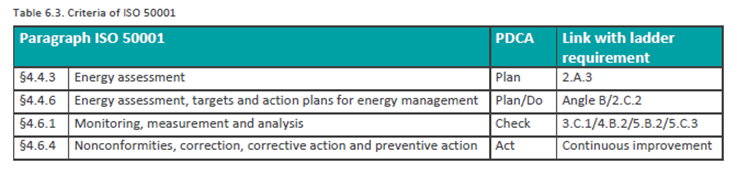
In Version 4.0 of the Ladder, ISO 50001 is similarly integrated into the certification requirements.
ISO 50001 is a binary system, while the CO₂ Performance Ladder is a multi-level system. When using ISO 50001, an organisation either meets the requirements and gets certified, or it does not. In contrast, when using the CO₂ Performance Ladder, organisations can choose from multiple levels to set as their goal. Some more ambitious companies may commit to level 4 or 5 in Version 3.1 (equivalent to step 2 in version 4).
The Ladder is designed for use as an award criterion in tenders, unlike ISO 50001, which has no procurement-specific implementation, though it is in practice often used as a selection or eligibility criterion.
Summary at a Glance
| Criteria | ISO 50001:2018 | CO2 Performance Ladder |
| Scope | A set of requirements for establishing an energy management system: managing energy performance to improve efficiency, use and consumption systematically | A set of requirements for establishing an energy and carbon management system: acquiring insight into and working to reduce energy and carbon use |
| Structure | Certifiable standard based on the Plan-Do-Check-Act cycle | Multi-level certifiable standard based on the Plan-Do-Check-Act cycle |
| Procurement | Indirect influence – can be used as selection or eligibility criteria in tenders | Multi-level incentivisation through fictitious discounts in procurement |
| Validation | Certification by an independent auditor is not a requirement. Self-assessment or third-party assessment is possible | Third party validation conducted by accredited certifying bodies |
| Cost Summary | Costs associated with purchasing the standard and third-party assessments (optional), and internal resources for implementation. | Costs include a contribution to the scheme manager (based on organisation size), internal resources for implementation, and third-party auditing fees. Auditing fees vary based on level, organization size and auditor |
ISO 50001:2018 and the CO₂ Performance Ladder share a common foundation in structured energy management and continual improvement, making them highly complementary tools for organisations seeking to reduce energy use and carbon emissions. While ISO 50001:2018 provides a globally recognised framework for energy performance, the Ladder adds a procurement dimension and incentivises broader CO2 reduction efforts across supply chains. Together, they offer flexibility and integration opportunities. Organisations can align or merge these systems to maximise efficiency, compliance, and sustainability impact.
By adopting the CO₂ Performance Ladder, future users can leverage its structured approach, procurement advantages, and supply chain engagement requirements to accelerate CO2 reductions and strengthen their competitive position. Ultimately, the Ladder serves not only as a management tool but as a catalyst for continual improvement, empowering organisations to innovate, collaborate, and contribute meaningfully to the wider energy transition.
If you want to know more about the Ladder, please contact Marianne
News
More news from IGBC
-

Faster decarbonisation of buildings will increase resilience to energy price shocks
Progress has been made on policies to decarbonise our built environment in recent years but the government must... -

Roadstone – Becoming the First Company in Ireland to Achieve Level 5 on the CO2 Performance Ladder
Introduction Roadstone Ltd, one of Ireland’s leading supplier of construction materials, has become the first company in Ireland... -

New research points way toward vibrant, nature-rich neighbourhoods
New research points way toward vibrant, nature-rich neighbourhoods Dublin, 11 May 2026: Better alignment between government policies and... -

Building for Biodiversity: IGBC and Local Authorities Join Forces
Local authorities, environmental experts, and construction professionals convened on the 14th April in Portlaoise for a landmark workshop... -

Wrapping Up Ireland’s CO2 Performance Ladder Pilot Project – A Major Milestone in Green Public Procurement
Ireland’s two-year pilot of the CO2 Performance Ladder (2023-2025), led by the Irish Green Building Council (IGBC) in... -

South East Energy Agency is Hiring
At South East Energy Agency, we’re expanding, and we’re looking for talented people to join us. Current opportunities:...