



Identifying Solutions to Scale-Up Measures for Nature in Residential Developments
Ireland is at a turning point in shaping its built environment. With a goal of 50,000 new homes...
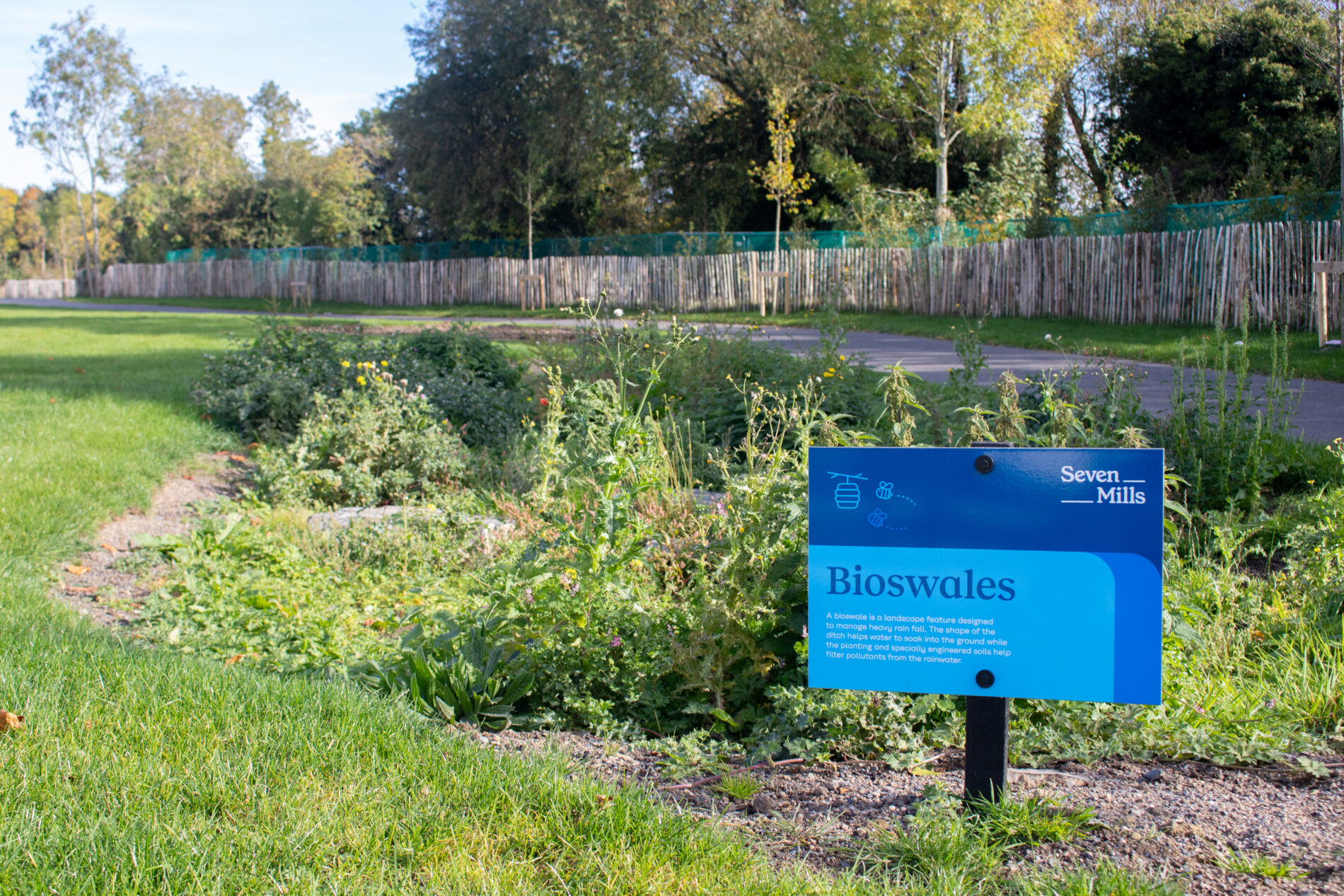
 Neighbourhood Park & SuDS Basin in Seven Mills development by Cairn Home
Ireland is at a turning point in shaping its built environment. With a goal of 50,000 new homes annually by 2040, today’s decisions will have lasting impacts on people, communities, and the planet. In this blog post, Fiona Nulty – project partner with Trinity College Dublin on the Housing Agency-funded BIO-NEIGHBOUR project – shares new research insights on scaling nature-led residential development.
Building on previous work
Initial research as part of the BIO-Neighbour project explored progress and awareness around the integration of nature-led measures in residential developments. Findings show that although integration of these measures on the ground is somewhat limited, there is an increasing sense of awareness among key stakeholders and built environment professionals. This sense of momentum is positive and is supported by moves in legislation such as the EU Nature Restoration Law and Ireland’s new National Planning Framework, which seek to give greater protection for biodiversity in the context of urban areas and sustainable development.
The research also examined barriers to progress and found that factors such as policy, legislation, knowledge and skill gaps, maintenance, enforcement, and financial barriers all impact the integration of biodiversity measures in residential projects. These findings underpinned the next stage of the research, which involved working with stakeholders in both public and private sectors, as well as reviewing national and international best practice, to identify possible solutions.
Finding new ways forward
The second part of the research identified various factors which would assist in overcoming barriers and working towards possible solutions. These fall under six key themes:
Green Infrastructure Planning: A strategic approach
The findings show that there is a need to plan strategically for nature at a national, regional and local level. The first step in nature-led residential development is to protect the existing high nature value sites, and to expand these where feasible. The implementation of the mitigation hierarchy: ‘avoid – minimise – restore – offset’, at the earliest possible project stage, is also a key factor in positive outcomes. Encouragingly, this approach has been included in the new National Planning Framework. An international example can be seen in the Netherlands, which has developed a National Ecological Network (NEN); protecting and expanding semi-natural habitats at a national scale. By planning our green infrastructure network in a strategic way, we support development at the earliest stage and minimise the delays and risks which can arise where projects negatively impact biodiversity.
Design and Delivery: Targets and Metrics
While sentiments around biodiversity metrics are often divided, research participants noted that a metric tool, when used in the correct context, can act as a central element in the development process, which drives change both upstream and downstream. Reports on the DEFRA BNG metric reveal issues with implementation: a survey by CIEEM found that 84% of practitioners feel there are major problems in implementing the tool on small sites. It suggests that the tool may be overly complex for certain scenarios. The BIO-Neighbour findings show that in the urban and semi-urban context, tools such as the Urban Greening Factor were regarded as having strong potential for positive impact. These frameworks evaluate the green spaces on a site using weighted calculations and set standard ‘Greening Factor’ targets depending on the location and zoning objective of the project. Their link with planning consent drives awareness across all design team members and ensures that biodiversity measures are considered early in the design process. Participants noted that to achieve the best outcomes for nature, a dual approach using different UGF metrics for brownfield and greenfield sites would be most suitable. Consideration must also be given to include mechanisms which prevent the pre-application clearance of natural features on development sites. This practice is ongoing, and its considerable impact on nature is often not captured within the current legislation, planning and policy systems.
Long-Term Management: Planning Ahead
A major issue in achieving sustained outcomes for nature in residential developments is the delivery of long-term management. Projects can show strong ambitions at the planning stage, and often these are delivered to practical completion. Over time, however, through factors such as communication breakdown or a lack of clear responsibility, appropriate management of semi-natural areas can fail, and the positive impact on nature is lost. Strengthening enforcement is one aspect of overcoming this, and Local Authorities must be better resourced to follow up on design intentions. Another solution identified in the research is to consider the management of Nature-based Solutions and Green Infrastructure in the same way as that of traditional infrastructure, such as roads or drainage. This applies to assigning responsibility, designing monitoring plans, and planning for long-term maintenance works. It is also critical to consider the management strategy for biodiversity measures as early as possible in the design process. An example can be seen through Scottish Water, whereby they have set a clear design standard for SuDS infrastructure based on the most effective measures shown by research. Once SuDS systems are designed to this standard, they will be taken over by Scottish Water.
Knowledge: Sharing Skills and Breaking Silos
The research showed that expert knowledge is available through skilled ecologists, but that this is often incorporated too late in the process. This means measures to protect biodiversity are being driven by mitigation, rather than the site ecology informing the initial design. To overcome this, it was suggested that ecologists should be involved at the earliest project stage, ideally before the purchase of development land. Local Authorities also need more planning ecologists in-house to input into applications and the development plan standards. Biodiversity is now a key project element which needs to be understood and considered by all design team members. To facilitate this, cross-disciplinary training modules on ecology and nature-led design must be developed for all built environment professionals.
Finance: Cost-Benefit Analysis
Nature-led residential developments can provide societal and economic contributions across all ecosystem services; however, this is not always recognised when it comes to financial considerations. The work of Natural Capital Ireland centres around how nature is valued in an economic sense and can provide greater detail. In terms of development projects, Bio-Neighbour participants noted the need to provide greater cost-benefit analysis on Nature-based Solutions to strengthen existing funding streams and generate new finance for nature. As one participant outlined: “the value is in air quality, natural flood management, transport, health, biodiversity. None of whom pays for it.” Clear, transparent financial calculations to show installation and maintenance costs for NbS compared to those of traditional approaches were also cited as a key factor in overcoming barriers and normalising biodiversity measures in development projects. Conveying the wider benefits to society, as shown in established research, will also champion the importance of nature in residential developments. Finally, targeting existing funding streams such as NTA funding or the URDF (Urban Regeneration and Development Fund) and embedding requirements for nature into these frameworks may also assist with scaling up positive measures.
Perceptions: Seeing nature as a benefit
The importance of an overall mindset shift was stressed by all participants across all professions. Currently, nature is often seen as a barrier to development and a project risk. This was noted as a core factor that must change to scale up positive measures for biodiversity. Education and communicating the benefits of nature to stakeholders and to residents can work towards changing the narrative. Public projects can also act as ‘best practice’ examples, demonstrating how solutions work on the ground, and allowing greater understanding by stakeholders, which encourages adoption. The recent swift box project by Mayo County Council is just one example which gives encouraging results: In 2024, a total of 383 external and built-in nest boxes were provided across the county, and 38% of Mayo’s population of breeding Swifts were shown to be using nest box compartments.
These solutions reflect considered approaches suggested by professionals such as ecologists, planners, architects, landscape architects, and developers across public and private sectors. They will feed into the next stage of the research and the final recommendations.

Next Steps: Testing ideas and finalising recommendations
A broad range of solutions has been identified, and the next steps will involve distilling these ideas and further refining them with input from built environment professionals. Multi-disciplinary stakeholder engagement is a core aspect of the BIO-Neighbour project and a crucial step in identifying feasible, practical, and implementable recommendations. The societal and economic co-benefits of healthy ecosystems are well established, and so embracing and working with nature in our residential developments is a positive step both for nature and people.
Engagement has been extremely positive, and a sincere thank you to everyone who has participated in the project to date. If you are interested in learning more, you can download the full reports below or contact Irene.
News
More news from IGBC
-

-

Faster decarbonisation of buildings will increase resilience to energy price shocks
Progress has been made on policies to decarbonise our built environment in recent years but the government must... -

Roadstone – Becoming the First Company in Ireland to Achieve Level 5 on the CO2 Performance Ladder
Introduction Roadstone Ltd, one of Ireland’s leading supplier of construction materials, has become the first company in Ireland... -

New research points way toward vibrant, nature-rich neighbourhoods
New research points way toward vibrant, nature-rich neighbourhoods Dublin, 11 May 2026: Better alignment between government policies and... -

Building for Biodiversity: IGBC and Local Authorities Join Forces
Local authorities, environmental experts, and construction professionals convened on the 14th April in Portlaoise for a landmark workshop... -

Wrapping Up Ireland’s CO2 Performance Ladder Pilot Project – A Major Milestone in Green Public Procurement
Ireland’s two-year pilot of the CO2 Performance Ladder (2023-2025), led by the Irish Green Building Council (IGBC) in...